Translate

Saturday, June 26, 2010

RETURN TO FRANKENSTEIN


What does one expect if you return to one of the Germany Villages of your ancestors, 300 years after their departure? An Oompah Welcome Band as below?
 
Or a retired hair dresser who just happened to be visiting her hair salon? In my case I met and talked to Mrs. Liesel Nabinger, a cousin many times removed, at her Nabinger Coiffeur (Salon) below:
Frankenstein, Saarland (94)
On June 4, 2010, I traveled to Frankenstein, in Pfalz on the Rhine, Germany, where many of the descendants of my earliest ancestors still live. Mrs. Liesel Nabinger and I are related through Johaan Heinrich Konrad Nabinger, who died in Frankenstein in 1762, and today Frankenstein is still the residence of many members of the Nabinger Family.

Glen Novinger, Austin, Texas

Saturday, February 20, 2010

UPCOMING TRIP TO WOLFERSWEILER, SAARLAND


CREST - SAARLAND..................................................SAAR RIVER

In June of this year I will be visiting Wolfersweiler, Saarland, Germany, to visit the home villages of the Novinger Clan.

No, I don't expect to find any Novingers after 270 years. The spelling of the Family Name has changed many times since the 1700's when the first Novingers left Saarland for the the USA. The Family name is recorded variously in the 1700's as Nabinger, Novinger, Nauvinger, Novenar, Nevenger, Navinger, Naevinger, and Narringer. But it would be rewarding if I did find someone with one of these family names!

According to the church records of the Wolfersweiler Reformed Parish Church, Theobald Nabinger, a hunter and woodsman, born 1714, from Wolfersweiler, Germany, married Maria Anna Margretha Schwab on January 2, 1742. This church is very old and a photo of it appears above. It was built in 1586 and rebuilt in 1788. The Church Parish included numerous villages within a five kilometer radius of the Parish Church in Wolfersweiler: Nohfelden, Gimbweiler, Hahnweiler, Walhausen, Mosberg, Eitzweiler, Asweiler, Richweiler, Deckenhardt, Steinberg, Gehweiler, and Hirstein. ( The "weiler" endings in most of the names translates from German as "hamlet" and most of these villages consist of only a few houses.) The Parish records show entries of Nabingers from the villages of Wolfersweiler, Asweiler, and Hirstein. So I will be visiting these villages in particular.

Should anyone reading this posting have information concerning the Nabingers, or a similarly spelled name, from Wolfersweiler or Zaarland, please share your information by posting to this blog.

I will report on my trip in June with photos from Saarland. Stay tuned to this Blog for new postings by clicking on the "Follow" button at the top left of the page.

Glen Novinger
Austin, Texas

Saturday, February 13, 2010

PICKING CORN BY HAND


For me the history of the Novinger Family is made up of the Stories of Family Members, the Places that Novingers have lived, and the Jobs and Experiences of Individual Family Members.

One of my earliest memories until 1946 when I was 7 on the farm near Unionville, Missouri, was of Dad picking corn by hand.


Since the whole process of taking care of the horses or mules, harnessing them each morning, picking the corn by hand, hauling it to the crib and unloading it was a slow-time consuming job, most of the winter months were spent harvesting the corn. Some days the weather was warm and sunny, other days it was cold and snowy!


But regardless of the weather there were several months of hand work to finish the harvest. The corn was picked by grabbing each ear, one at a time, and twisting it off the stock, and throwing it into the wagon. But the ears didn't volunteer to be picked! You first had to strip the shucks off of the ear and while holding the stock of the ear in one hand, twist the ear to break the stock, and then throw it in the wagon. To pick several wagon loads per day this process had to happen in 1 to 2 seconds per ear. To strip the shucks off of the ear, there were several types of hooks or "husking pegs" that were used to strip the shucks off of the ear. The shucking hook below is the very one used by my Dad, Frank Novinger and is still in the Family.


Husking Hook of Frank Novinger
Used by him from about 1937 to 1946

This work was hard on the hands, hard on your back, and hard on your feet. So when Dad got a Farmal "H" Tractor in 1946, it was a lifesaver for him, that with the mechanical corn picker, saved months of work each year.


International Farmal "H" Tractor

So fast forward from 1964 to the early years of 2000+ and corn picking is a lot more efficient in Missouri today. Corn is harvested by corn harvesters that can pick and shell semi truck loads of shelled corn in fraction of a day. All while the operator is sitting in an air conditioned or heated cab talking on a cell phone or listening to the radio.


But meanwhile in year 2010 Glen Novinger, who grew up in Missouri and has seen agriculture modernize around the world over the past 6 decades, is now living part time in Patzcuaro, Michoacan, Mexico. And how do they harvest corn in Michoacan? By hand! But the process is not as advanced as it was in Missouri in 1946. In Michoacan today the corn is picked by hand, placed in a gunny sack, and carried out of the field by the farmer on his back. Horses are not yet widely used for farm work in Michoacan today.


Glen Novinger in front of a corn field in Michoacan, Mexico, in 2010. After hand picking the ears of corn the stocks are stacked upright to be taken in later and used as fodder for the farm animals.

Wednesday, December 16, 2009

Sunday, May 24, 2009

SAARLAND: HOMELAND OF THE NOVINGER CLAN

HOMELAND of the NABINGER / NOVINGER FAMILY
Map of Europe_edited-1 copy
SAARLAND: shown inside purple line.
Saarland is a small territory in Western Europe that has never been a major power. But it has frequently been at the cross roads of power and has been controlled by each of the tribal leaders, kings, or Emperors as they have prevailed from time to time. Saarland is located at a central point of Western Europe north of the Alps and its territory has been an area to dispute for thousands of years.

Prior to the time of Christ the area was settled by Celtic tribes. Then in the first century BC, the Roman Empire made the region part of its province of Belgica. Roman rule ended in the 5th century when the Franconians conquered the territory. The region was then divided into several small territories ruled by sovereigns of adjoining regions. But over more than 1000 years, the Saarland gained a wide range of independence.

Then the region was conquered in 1792 by the armies of the French Revolution and made a part of the French republic. France incorporated Saarland into their Department de la Sarre (After the Sarre, or Saar, River that runs through the area on its way to the Rhine River.). After the defeat of Napoleon in 1815 the area was divided into 3 areas ruled by the Prussian Rhine Province, the Kingdom of Bavaria, and the Duke of Oldenburg. And then after the Franco-Prussian War of 1870/71 the Germany Empire was founded and the Saar Region became part of the country we have since known as Germany.

After the World War I, beginning in 1920, the Saarland was occupied and administered by France under a 15 year League of Nations mandate. As a foreign occupied region of Germany, toward the end of this mandate Saarland became haven for anti-Nazi political opponents. But in 1935 a plebiscite voted in favor of rejoining Germany and a Nazi, Josef Burchel as appointed the German Reich's commissioner for reintegration of Saarland. After World War II Saarland again came under French occupation as the Saar Protectorate. In 1954 France and Germany signed an accord establishing an independent Saarland, but a plebiscite held on October 23, 1955, rejected independence and in favor of joining the Federal Republic of Germany. With the signing of the Saar Treaty on October 27, 1956, Saarland was joined to Germany.
One interesting provision of the Saar Treaty established French as the required first foreign language taught in Saarland schools. Since 1971 Saarland has been a member of SaarLorLux, a euroregion created from Saarland, Lorraine, Luxembourg, Rhineland Palatinate, and Wallonia.

The residents of Saarland once spoke a German dialect known as Rhine-Franconian, with many imported French based words.
saarland (2)
Theobald Nabinger, later known as Dewalt Novinger, the founder of the Novinger Family in the United States, left Wolfersweiler, Saarland, in March or April of 1742 to travel to the United States. Wolfersweiler is located north of Saarbrucken, near Nohfelden, in the map above.
Growing up in Missouri the Novinger Family had frequent family gatherings and I often heard mention of our family background. The details were "sketchy" and one often heard that we were descended from the Dutch, the Irish, the Swiss, Germans, and/or the French. The Dutch certainly came from the “Pennsylvania Dutch”, which were of course the German speaking Novingers who settled in eastern Pennsylvania. This is fairly accurate. The Irish referred to a verbal story of Theobald Nabinger traveling through Ireland and marrying an Irish woman. More recent research indicates that this was inaccurate. The French ancestry had some reason in that Saarland is the most French of present day Germany states and it has had occupation by the French and the adoption of words from the French language over the centuries. In point of fact, during the years of the migration of the Novingers to American, France was reasserting its control over the area and by 1782 had conquered Saarland and made it part of the France Republic. We now know that the Novinger Family is descended from the Nabingers of Frankenstein, Saarland, Germany.
Wolfersweiler Church - 2010
WOLFERSWEILER as it appears today.

Reference Book: Dewalt Novinger's Legacy

Dewalt Novinger's Legacy
"The Novinger Family in the United States from 1737 to 2001"


Vail Fruechting of Wichita, Kansas, contacted me recently. His 5th Grandfather was Theobald Nabinger and therefore is directly related to the Novinger Family of Missoui. Vail was looking for additional information on the Novinger Family History and I referred him to the following book:

Dewalt Novinger's Legacy - "The Novinger Family in the United States from 1737 to 2001"
This book was compiled by James G. Novinger of the Novinger Reunion, published in 2002, and printed by

Masthof Press
219 Mill Road
Morgantown, PA 19543-9516
Library of Congress Number: 2001095766
http://www.masthof.com/


This book has a wealth of information on the family since we arrived in the United States. But it had been out of print for some time. Vail let me know that he checked with Masthof Press and he was able to order 2 copies. I can highly recommend this book and Masthof Press may have some more copies.

( June 7, 2009 - UPDATE: Vail was apparently mis-informed. He did not get the books he ordered. Apparently the book is not currently available. See his comment to this posting.)

Friday, January 18, 2008

Earliest Novinger Family History

Novinger Family History
The earliest record of the Novinger Family in the United States dates from Theobald Nabinger, a hunter and woodsman, born ca1714, in Wolfersweiler, Saarland, and now part of Germany. Wofersweiler is a small village of approximately 1,000 people in the Nahe Valley, located in a western region of Germany which is known today as Saarland. Saarland is close to the borders of both Luxembourg and France. Theobald was the son of Johann Konrad Nabinger, a municipal official of Franchenstein, now part of the District of Kaiserslautern. His marriage to Maria Anna Margretha Schwab Wagner, (who already had 13 children by a previous marriage) is recorded in the records of the Wolfersweiler Reformed Church on January 2, 1742. Maria was the widow of Herr Oberforster Jno. Michael Wagner, born 1689, died Fedruary 8, 1741, for whom Theobald worked before the death of Herr Oberforster.


Wolfersweiler Reformed Church

It is estimated that Theobald Nabinger left Wolfersweiler in March or April of 1742 for Pennsylvania in America, only 2 or 3 months after marrying the widow Wagner, because he arrrived in Philadelphia on the "Loyal Judith" on September 3, 1742, with 90 Palantine Germans, or "freights". It appears that he left without the Widow Wagner, as she died in Wolfersweiler on January 23, 1761.

Upon arrival in America, Theobald Nabinger “disappears” for nine years and it is assumed that in order to acquire passage that he traveled as an indentured servant (the common method for Palantine Germans to travel to America) and spent 9 years working off his passage to America. He first reappears on the 1751 Lancaster County Pennsylvania tax rolls, when he filed an application for 25 acres of land in Warwick Township. His name soon evolves through various forms as Theobald & Dewalt and either Nabinger, Navinger, Nauvinger, and finally Dewalt Novinger. Several other larger land purchases in Lancaster County by Dewald Nabinger and Dayvolt Nabinger occurred in the following years.
From 1768 to 1848 there are several Dewalt and Theobald Novingers living in the Lancaster County area. It is not known for sure when or where Theobald (Dewalt) Nabinger (Navinger) from Wolfersweiler died, or where he is buried. However, there is a Dewalt Novinger buried in 1780 in the Saint David's Church Cementary in Killinger, PA, originally part of Lancaster County, PA.


Tombstone of Dewalt Novinger

Jonathan C. Novinger, the eldest son of Dewalt (Theobald) Novinger and Mary Woodside, lived in Dauphin County, PA, until moving with the majority of his family to Adair County, MO, in 1848. Upon his arrival in Missouri Jonathan C. Novinger homesteaded 80 acres in northeast Missouri and build a log cabin. Soon thereafter representatives of a railroad came through the area seeking right-a-way and lumber for railroad ties. Showing good Novinger Business Sense, Jonathan offered the railroad the lumber for free, if they would only construct the railroad through his 80 acres and build a depot on his land. It was done and the town of Novinger was established which today has about 600 residents. Between 1986 and 1988 the Novinger Renewal, Inc. moved the original Novinger Cabin to the City Park and restored it as a museum of the Novinger Family and Town.

Novinger Cabin, City Park, Novinger Missouri
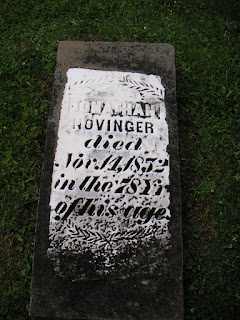
Jonathan died on November 14, 1852, and is buried in the Novinger Missouri Cemetery. It is from Jonathan C. Novinger that I, and the Novinger Family of Missouri, am descended.
Tombstone of Jonathan C. Novinger